
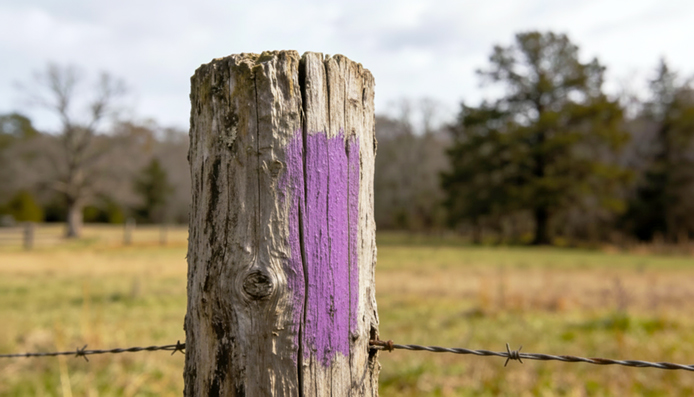
The Story Behind the Purple Paint Law:
How a Simple Mark Became Legal “No Trespassing”
If you’ve ever wandered through rural woods or open countryside and
spotted trees or fence posts marked with bright purple stripes, you
might have wondered: What does that mean? In several U.S.
states—including Arkansas—the answer is simple: No Trespassing. But how
did this unusual practice become law? Let’s explore the origins, legal meaning,
and history of the purple paint law, starting right here in Arkansas.
🎨 Where It Comes
From: Arkansas’ Innovation in Property Posting
The concept of using purple paint to mark property wasn’t originally a
stylistic choice—it was a practical legal innovation.
In 1987, Arkansas became the first state in the U.S. to pass a
law recognizing purple paint markings on trees and posts as the legal
equivalent of a “No Trespassing” sign. Before this, landowners wanting to
warn off would-be visitors against trespassing relied on physical signage—metal
or wood signs that were costly to install and easy to steal, vandalize, or
deteriorate over time.
Lawmakers and rural landowners saw a simpler, more durable alternative: a
painted stripe that would be weather-resistant, hard to remove, and
instantly visible in wooded or open land. Purple, as a color seldom found
naturally in rural landscapes and highly visible against greenery and tree
bark, made an ideal choice.
This Arkansas law standardized how the paint had to be applied:
- Vertical marks at least 8 inches
long, placed on trees or posts,
- Between 3 and 5 feet above ground, and
- Spaced at regular intervals along a property boundary,
especially at likely access points.
That simple arrangement gave landowners a low-cost, effective way to
legally establish that their land was “posted” and that unauthorized
entry could be prosecuted—just like if a “No Trespassing” sign had been posted.
📜 Legal Meaning:
Purple Paint as Public Notice
Under Arkansas law, when a property is posted with the authorized purple
paint markings, it’s legally considered the same as posting a sign. That means:
- A person entering the land
without consent after seeing the markings can be charged with criminal
trespass, and
- Because paint marks can’t be
stolen or knocked down like signs, there’s less ambiguity over whether
notice was given.
The Arkansas Department of Agriculture even prescribes the exact shade
of purple paint used for posting, ensuring uniform visibility and legal
consistency across the state.
🌎 From Arkansas to
Across the Country
The purple paint law caught on. After Arkansas led the way in the late
1980s, other states recognized the same benefits and adopted similar
statutes:
- Missouri and North Carolina passed purple paint laws in the
early 1990s,
- Texas followed in 1997, and
- In subsequent years dozens of
states—from Florida and Illinois to Pennsylvania and West Virginia—adopted
their own versions of the law.
Today, roughly 20+ states legally recognize purple paint markings as
adequate notice of no trespassing, with each state having its own rules
around spacing and placement, but all rooted in that original idea: paint
can be just as clear—and more durable—than a sign.
🎯 Why This Matters
For landowners, the purple paint law is more than an odd curiosity—it’s a
practical tool that:
- Saves money on signs,
- Reduces maintenance and vandalism
issues, and
- Provides a legally enforceable
way to protect private land in rural and forested areas.
For hikers, hunters, and outdoor enthusiasts, learning to recognize these
markings helps avoid accidental trespassing and the legal trouble that can come
with it.
Next time you see a purple stripe in the woods, you’ll know it’s not
graffiti—it’s a quiet but official boundary line rooted in Arkansas legal
history.